
Blog
Manual Vs Automated Warehousing: Cost and Efficiency Comparison

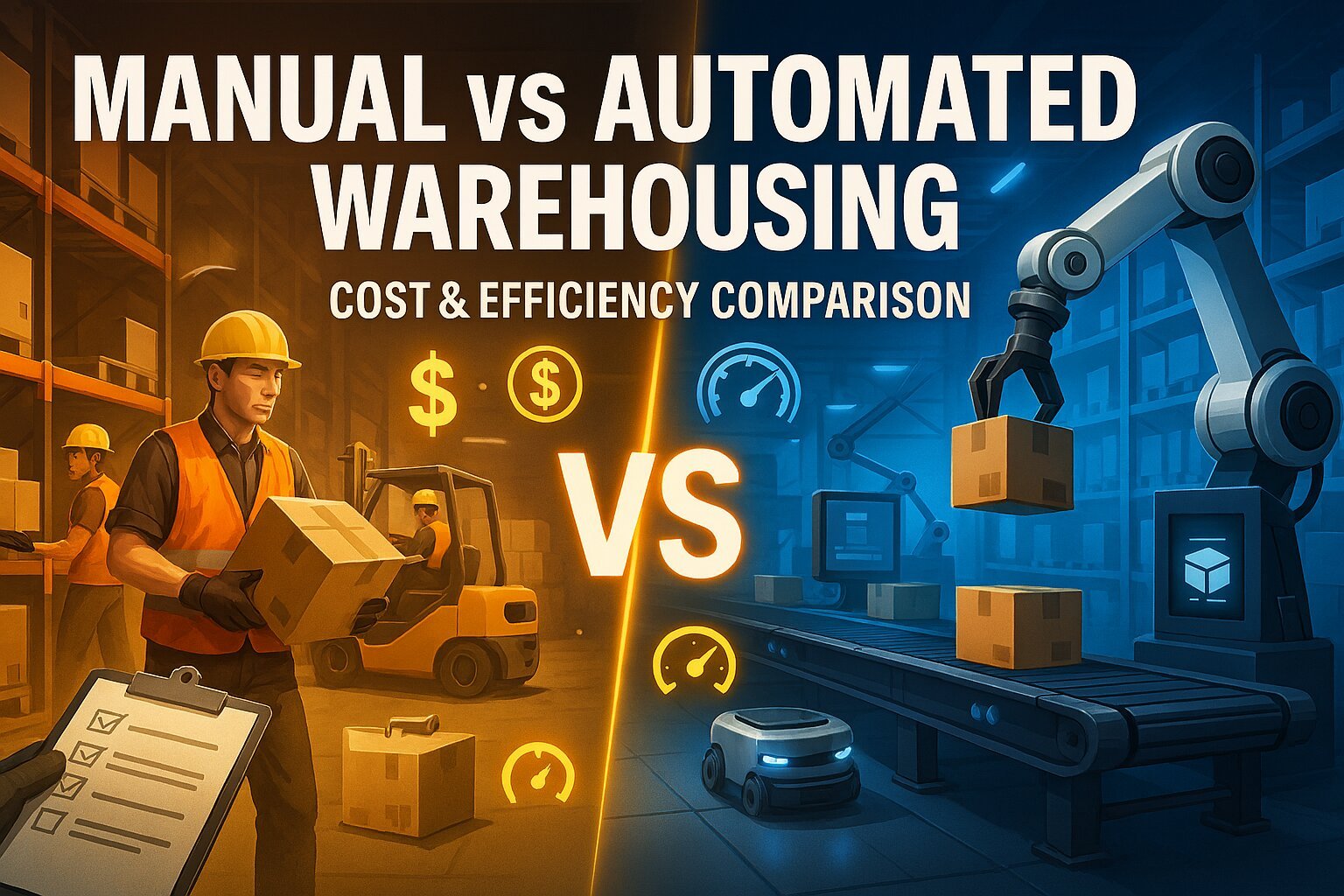
Warehousing is an important process in supply chain management, particularly in the manufacturing, retail, e-commerce, and logistics industries. The expansion of businesses presents one of the biggest business operations choices of whether to stay with manual warehousing or invest in automated warehousing. The two models have strengths and weaknesses concerning cost, effectiveness, scale, and value in the long run. The knowledge of the difference has assisted businesses in selecting the appropriate strategy based on the budget, level of operation, and intended growth.
Master Racks Limited is here to let you know about manual vs. automated warehousing! Keep reading!
What is Manual Warehousing?
Manual warehousing is dependent on human labor to perform the work like:
● Picking and packing
● Inventory management
● Loading and unloading
● Stock counting
● Material movement
The workers have access to forklifts, pallet jacks, hand scanners, and a simple warehouse management system (WMS) to accomplish tasks. Small to medium-sized businesses, as well as warehouses with moderate volumes of inventory, often use manual systems. Many growing facilities such as garment and textile warehouses in Bangladesh still rely heavily on manual operations due to workforce availability.
What is Automated Warehousing?
Automated warehousing is a technology that is used to automate operations. This may include:
● Automated Storage and Retrieval Systems (AS/RS)
● Conveyor systems
● Picking and packing robotics
● Automated guided vehicles (AGVs)
● A combination of warehouse management software
Automation lowers the dependency on the human factor and increases the accuracy of operations. Large distribution centers and large-volume e-commerce operations are likely to have automated warehouses, especially those implementing advanced warehouse solutions to maximize efficiency.
Comparison of Costs: Automated and Manual Warehousing
Many businesses are usually determined by cost. Let’s break it down.
Initial Investment
Manual Warehousing:
● Lower upfront cost
● Shelving, forklifts, and simple equipment are all required.
● Low level of technology infrastructure.
This renders manual systems appealing to start-ups or businesses with a small capital base.
Automated Warehousing:
● High initial investment
● Needs conveyors, robotics, and automation software
● WeARP installation and system integration expenses
Automation is also very expensive in terms of capital outlay, and this might not be viable for small businesses.
Winner: Manual Warehousing.
Labor Costs
Manual Warehousing:
● Excessive dependence on the labour force.
● Continued salaries and overtime expenses.
● Training and recruiting costs.
● The higher the volume of the warehouse, the higher the labor costs.
Automated Warehousing:
● Fewer human resource needs.
● Reduced long-term wage costs.
● Reduced costs of human error.
● Automation saves the extreme dependence on labor in the long-term.
Winner: Automated Warehousing.
Maintenance and Operating Costs
Manual Warehousing:
● Maintenance of equipment (forklifts, pallet jacks)
● Expenses on workforce management.
● Greater threat of losses due to human error.
Automated Warehousing:
● Software updates and system maintenance.
● Technical sustenance needs.
● Costs associated with a possible downtime in the event of a system malfunction. Although automation minimizes human error, technical maintenance is very costly.
Balanced Comparison: Relies on the level of operation and the complexity of a system.
Comparison of Efficiency: Manual vs. Automated Warehousing
Productivity, accuracy, and the performance of the operations are all based on efficiency.
Speed of Operations
Manual Warehousing:
● Slower picking and packing
● Relies on the productivity of the workforce
● Limited by human capacity
Automated Warehousing:
● Faster order fulfillment
● 24-hour working with little interruption
● Stable levels of performance
To a large extent, automation boosts order processing speed.
Winner: Automated Warehousing.
Precision and Minimization of Error
The manual systems are prone to human errors, mostly in big warehouses.
Manual Warehousing:
● Risk of incorrect picking
● Inventory miscounts
● Data entry errors
Automated Warehousing:
● Integration of barcode scanners
● Inventory tracking in real-time
● High picking accuracy rates
This is because automation lowers the error rate and enhances inventory accuracy.
Winner: Automated Warehousing.
Space Utilization
Manual Warehousing:
● Greater aisles to allow forklift movement.
● Weak vertical optimization.
Automated Warehousing:
● Maximizes vertical storage
● Narrow aisle systems
● Compact layout design
Automation will enable more effective utilization of warehouse space and can result in a decreased area of facility sizes. Businesses comparing systems often review local vs imported racking systems in Bangladesh to ensure optimal space performance.
Winner: Automated Warehousing.
Scalability
Warehousing requirements also rise with the expansion of the business.
Manual Warehousing:
● Needs to recruit additional employees
● Expanding physical space
● More complicated operations
Automated Warehousing:
● The system can be upgraded
● Deals with large quantities effectively
● Reductions in reliance on workforce growth
● Long-term growth can scale better with automation
Winner: Automated Warehousing.
When is Manual Warehousing the Best Alternative?
Manual warehousing can be more appropriate for:
● Small businesses
● Low-capital startups.
● Low inventory turnover warehouses.
● Companies that are at initial stages of development.
● Business operations in areas of cheap labor.
In case order volume can be handled, manual systems are still affordable.
When is Automated Warehousing More Advantageous?
Automated warehousing is suitable for:
● Large distribution centers
● Businesses engaged in e-commerce in large scale
● Companies with rapid growth
● Companies that are looking to be efficient in the long run
● High-accuracy operations
● In high-demand environments, automation gives superior ROI. Rapidly scaling businesses investing in storage solutions for e-commerce businesses in Bangladesh often move toward automation.
Smart Middle Ground Hybrid Approach
A hybrid warehousing model, which is a combination of selective automation and manual labor, is practiced by many businesses.
Examples include:
● Inventory tracking through automated means with manual picking.
● Human-monitored conveyor belts.
● Partial robotic assistance
This will be a compromise between the cost and efficiency without a complete investment in the automation.
Before making a choice, the following are the important considerations. Businesses ought to consider before making a decision:
● Budget availability
● Volume orders and projections of growth.
● Labor market conditions
● Technology readiness
● Space limitations
● Long-term operational goals
The long-term efficiency should not be at the cost of short-term savings. Consulting the right rack supplier in Bangladesh can also influence long-term warehousing performance.
Cost effectiveness vs Efficiency
Comparisons of manual and automated warehousing:
● Manual warehousing is beneficial in low-upfront ventures.
● Automated warehousing is faster, more precise, scalable, and efficient.
● Automation can be better in the long run, even with increased initial expenditure, in the case of businesses that are planning to grow steadily and that have large volumes of inventory.
● Manual warehousing is viable and economical to small scale operations that have low budgets. Companies researching the top industrial racking companies in Bangladesh can better plan infrastructure investments.
Conclusion
The decision on whether to have manual warehousing or automated warehousing depends on the size of the business, its scale of operations, and future aspirations. Manual systems are cheap and easy to use, whereas automated systems are efficient, accurate, and scalable. Hybrid solutions have become popular due to the need for businesses to create a balance in terms of investment and performance in many growing businesses. For long-term planning, understanding the future of warehouse management in Bangladesh is equally important.
Hopefully, this guide on manual vs. automated warehousing has been insightful!